While Everyone Argues About AI, Local Search Is Quietly Exploding
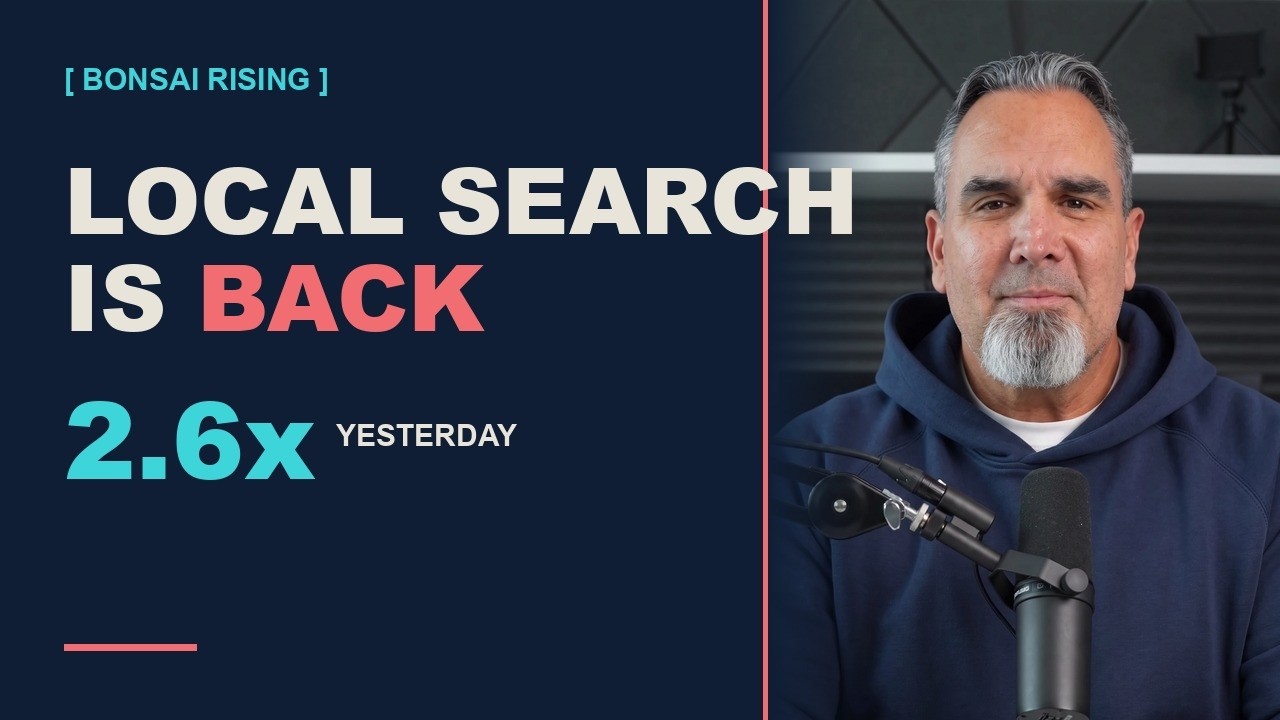
Search demand for local SEO jumped 2.6x overnight — from 1,400 to 3,600 views per hour. While the industry debates AI, the map pack is quietly paying local businesses' rent.
Search demand for local SEO jumped 2.6x overnight — from 1,400 to 3,600 views per hour. While the industry debates AI, the map pack is quietly paying local businesses' rent.
Search interest in local SEO spiked 2.6x in a single day, from roughly 1,400 to over 3,600 views per hour — and nobody in the industry reported it.
The map pack behavior hasn't changed in 10 years: someone searches 'plumber near me,' sees three businesses, and calls one — AI has not disrupted that loop.
Most local businesses are leaving money on the table with wrong categories, unlisted services, unanswered reviews, and stale photos — none of it requires a strategy deck, just an afternoon.
The AI engines everyone is chasing — ChatGPT, Gemini, Perplexity, Google AI Overviews — pull from the same structured local data as the map pack, so getting the basics right feeds both channels.
The businesses winning local search right now are not the ones with the best AI strategy. They are the ones doing the obvious thing consistently while everyone else reads about robots.
Search demand for local SEO jumped 2.6x in a single day last week — from a steady summer baseline of roughly 1,400 views per hour to over 3,600. It happened quietly. No headlines. No industry newsletters picked it up. And it is probably the most useful signal in local marketing right now.
The Map Pack Is Not Going Anywhere
While the marketing industry has spent the last year debating AI, local search has been running its same reliable play. Someone types plumber near me. They see three businesses. They call one. That behavior has not changed in 10 years, and AI has not changed it either.
Business owners are noticing. They have been reading that nobody clicks links anymore, and they are looking around for the channel that still produces a phone call this quarter. When they look, they find the map. That is what is driving the spike.
This is not a trend. It is a correction. Attention drifted toward what was exciting, and now it is drifting back toward what pays rent.
The Gap Between Agency Excitement and Business Reality
Here is the honest tension: the conversation inside marketing agencies has gone almost entirely to AI search — how to show up in ChatGPT, Gemini, Perplexity, and Google AI Overviews. That conversation matters. It genuinely does.
But a gap is opening up between what agencies are excited about and what actually moves the needle for a local business this quarter.
The Google Business Profile is not the exciting story. It is the story that pays. And most local businesses are leaving straightforward money on the table there right now.
What the Audit Almost Always Finds
These are not edge cases. They show up in nearly every local business profile:
- A primary category that is close to right but not exact
- Services that exist in the real world but are never listed in the profile
- Dozens or hundreds of reviews sitting unanswered for months
- Photos that haven’t been updated in years
- Hours that go stale every holiday season
None of that requires a strategy deck. It requires an afternoon.
Why This Connects Directly to AI Visibility
Here is the part that reframes the whole conversation: the AI engines everyone is chasing are reading the same structured local data as the map pack. When ChatGPT or a Google AI Overview names a business in your city, it is pulling from the same profile, the same reviews, the same citations that feed your local ranking.
Getting the boring stuff right is not the alternative to AI visibility. It is the input to it.
A neglected Google Business Profile does not just cost you map pack placement. It costs you presence in the AI answers your future customers are already reading.
Your One-Afternoon Play
The actionable version of this is genuinely simple. Open your Google Business Profile today and check three things.
First, is your primary category the exact phrase you most want to rank for — not close, exact? Second, is every service you sell listed as a service with its own description? Third, when did you last reply to a review? If it has been more than a month, that is your project this week.
Do those three things and you will move. Not because the tactic is clever, but because almost nobody does it consistently.
The businesses winning local search right now are not the ones with the most sophisticated AI strategy. They are the ones who did the obvious thing, repeatedly, while everyone else was reading about robots.
As AI search matures and the structured data layer becomes the foundation for answers across every engine, the businesses that built that foundation early will be the ones who are already everywhere when everyone else starts paying attention.
Answered.
Why did local SEO search demand spike so suddenly? +
Business owners are getting nervous about AI disrupting their traffic and are looking for channels that still reliably produce phone calls. The map pack delivers that, so attention is returning to it. The spike — from about 1,400 to over 3,600 views per hour — reflects that quiet, practical pivot.
Does AI search make Google Business Profile less important? +
The opposite. ChatGPT, Gemini, Perplexity, and Google AI Overviews pull from the same structured local data — your profile, reviews, and citations. A well-maintained Google Business Profile is an input to AI visibility, not a fallback from it.
What are the most common Google Business Profile mistakes local businesses make? +
Wrong or imprecise primary category, missing service listings with descriptions, unanswered reviews, outdated photos, and hours that go stale around holidays. These are straightforward fixes that most businesses never make.
How quickly can fixing a Google Business Profile move the needle? +
Bryan describes it as a one-afternoon job. Correcting your primary category, listing every service with a description, and responding to reviews are unglamorous tasks — but almost nobody does them consistently, which is exactly why they work.
Is local SEO still relevant in an AI-first search environment? +
Yes. The core behavior — type a local query, see a short list, make a call — has not changed in a decade and AI has not changed it either. Local intent still resolves at the map pack, making that channel durable even as the broader search landscape shifts.