From Storefront to Story World: How We Rebuilt Spice Sensuality
Spice had 15,000 products and a website that felt like a spreadsheet. Bonsai rebuilt it into a story world — with AI, guides, video, and a brand that shifts with the calendar.
Spice had 15,000 products and a website that felt like a spreadsheet. Bonsai rebuilt it into a story world — with AI, guides, video, and a brand that shifts with the calendar.
A massive product catalog means nothing if the site doesn't feel like the store — brand atmosphere is infrastructure, not decoration.
Bonsai built Ask Spice, an AI adviser that surfaces real inventory, real prices, and a real person one tap away — turning browsing into guided discovery.
Content written the way staff actually talk at the counter outperforms SEO-stuffed copy every time — voice builds trust faster than keywords.
Every video Bonsai produces gets at least three lives: YouTube, a shoppable blog post, and a two-week social calendar.
Seasonal brand identity — like the Midnight at Spice Halloween mode — can be built once and activated with a single switch, making consistency effortless.
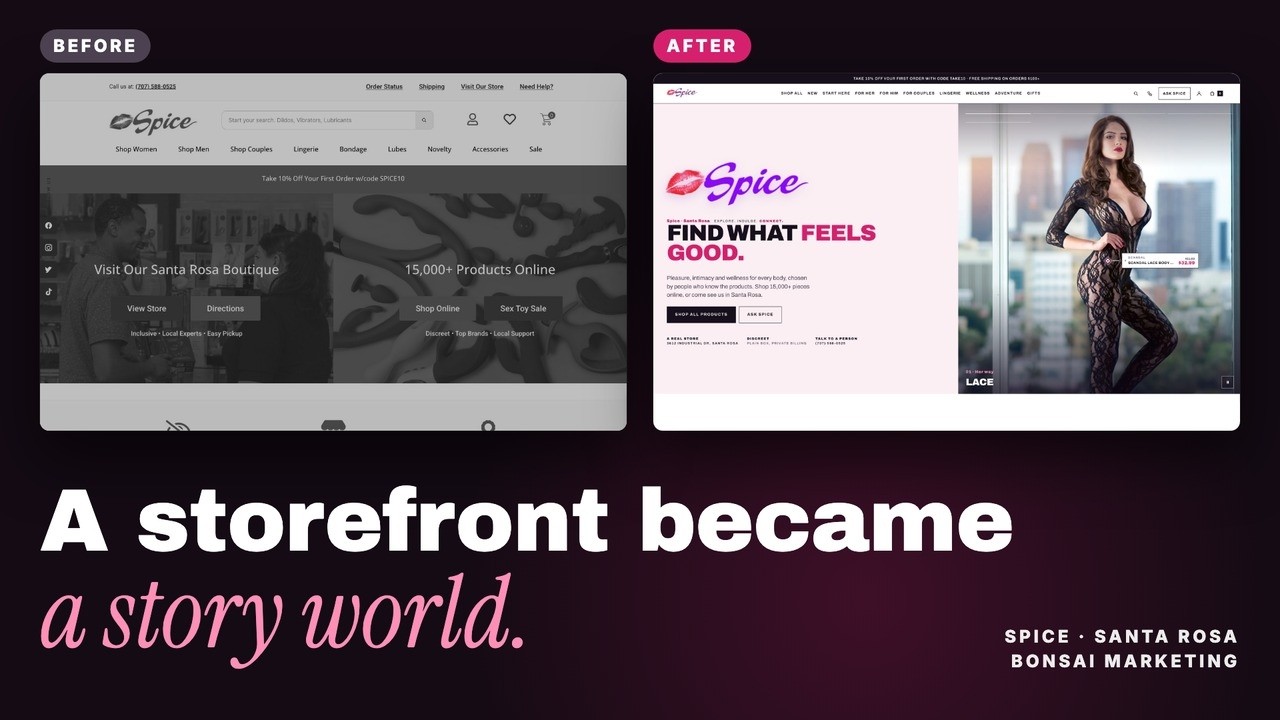
Spice is a boutique in Santa Rosa, California, with more than 15,000 products online. When they came to Bonsai, the inventory was all there. The problem was everything else. The site felt like a warehouse manifest — search bar up top, a long menu, sale banners, and product pages where the photo didn’t even load. Nothing about it felt like Spice. So we didn’t redesign it. We rebuilt it with intention.
One Feeling Before Anything Else
The first decision was editorial, not technical. What should a visitor feel the moment they land? We landed on four words: Find what feels good. That became the lens for every page that followed.
We rebuilt the site natively on the platform Spice already owned — no migration risk, no new learning curve for the team. What changed was the experience. Real product photography. Clear paths organized around how people actually shop: for her, for him, for couples. And the physical store itself woven into the story, not buried in the footer.
Writing the Way the Counter Talks
The guides we wrote don’t sound like product descriptions. They sound like the staff member who actually knows what they’re talking about and isn’t going to make you feel strange for asking. First toy. Lube for couples. Beginner’s questions answered plainly.
No jargon. No judgment. Just useful information written at the register level.
This matters beyond user experience. AI answer engines — ChatGPT, Perplexity, Google AI Overviews — pull from content that’s clear, specific, and authoritative. When your guides sound human and answer real questions directly, they get cited. That’s visibility that a product grid will never earn.
Ask Spice: AI That Knows the Shelf
We built Ask Spice directly into the site — an AI adviser that searches live inventory in real time. Ask for an anniversary gift under $40 and it returns actual products, actual prices, and a one-tap path to a real person on staff.
This isn’t a chatbot that deflects. It’s a guided shopping experience that closes the gap between browsing and buying, and it runs on what’s actually in stock right now.
Why This Matters for Boutique Retail
Small and mid-size retailers compete against platforms with infinite ad budgets. An AI adviser changes that equation. It gives the boutique experience — personal, knowledgeable, responsive — at scale, any hour of the day.
A Video Engine Built for More Than Views
The content strategy runs on short-form video, but not the kind that exists to fill a feed. Each video is built around one specific idea — bedroom tech support, skip the candle — light enough to share, specific enough to land.
And every video gets more than one life:
- Published to the Spice YouTube channel
- Converted into a blog post featuring the exact products from the video
- Expanded into a two-week social calendar
One production. Three content assets. That’s how a small team punches above its weight.
A Brand That Moves With the Calendar
Seasonal identity isn’t a luxury for big brands. We built Midnight at Spice — a Halloween mode that shifts the entire visual atmosphere from subtle to fully immersive, then resets cleanly when the moment passes.
It’s built once. It activates with a switch. The team doesn’t have to rebuild anything or hire a designer every October.
This is what a story world looks like in practice — a brand that has a voice, a rhythm, and a presence that extends well beyond the product page.
Spice didn’t need more products. It needed a site that was as good as the store. What comes next is making sure the engines — AI and search alike — know exactly who Spice is and what it’s built for.
Answered.
What did Bonsai Marketing actually rebuild for Spice? +
Bonsai rebuilt the Spice website natively on the platform Spice already owned, adding real product photography, clear navigation paths for her, him, and couples, conversational buying guides, an AI adviser called Ask Spice, and a video content engine with a matching social calendar.
What is Ask Spice and how does it work? +
Ask Spice is an on-site AI adviser that searches live inventory to answer shopper questions with real products, real prices, and a direct path to a real person. It turns a question like 'anniversary gift under $40' into a curated, shoppable answer.
How does Bonsai turn a single video into ongoing content? +
Each short-form video is published to YouTube, converted into a blog post featuring the products shown, and expanded into a two-week social media calendar — three distinct content assets from one production.
Why did the old Spice website fail despite having 15,000 products? +
The site functioned as a catalog — search bar, long menus, sale banners, product photos that didn't load — but it had no atmosphere, no voice, and no sense of the in-store experience that made Spice a destination.
Can a brand's visual identity shift for seasonal campaigns without a full redesign? +
Yes. Bonsai built Spice a seasonal identity system — like Midnight at Spice for Halloween — that toggles between subtle and immersive with a single switch, then resets cleanly after the campaign ends.