We rebuilt a drywall contractor's website in one day — without losing a single ranking signal
Patches In A Day has been in business since 1998 and holds a 4.9 rating across 450 Google reviews, with a website that looked like everyone else's. Bonsai rebuilt the entire site in one day: zero broken links, every ranking signal preserved.
Patches In A Day has been in business since 1998 and holds a 4.9 rating across 450 Google reviews, with a website that looked like everyone else's. Bonsai rebuilt the entire site in one day: zero broken links, every ranking signal preserved.
Preserving every URL, redirect, Google tag, and ranking sentence during a full rebuild is what separates a real site migration from an expensive mistake.
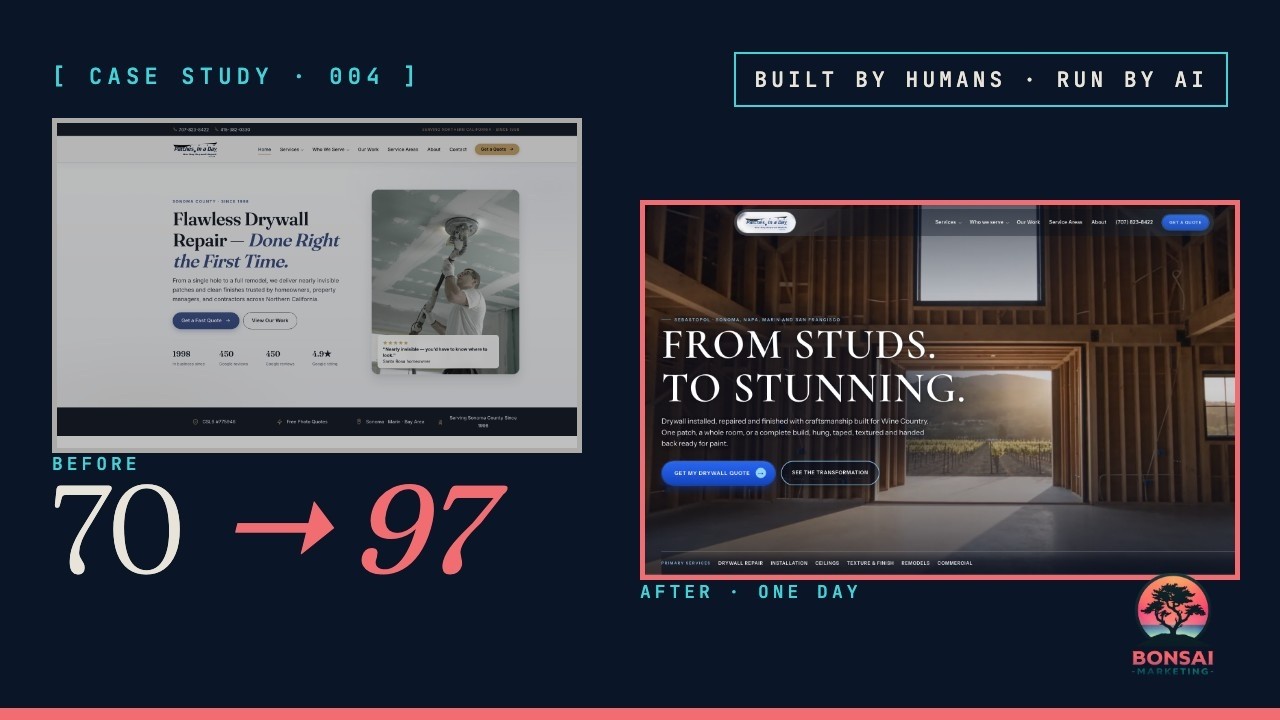
Mobile performance jumped from 70 to 97 after the rebuild — proof that a cinematic, brand-matched design and technical performance are not in conflict.
AI agents handled the 2,400-link crawl, accessibility audit, contrast math, and redirect checks; human judgment directed every decision that required it.
31 custom animated icons were built to illustrate the actual work — the hole closing, the knife sweeping the seam — not generic contractor clip art.
A geographic hub covering Sonoma, Napa, Marin, and San Francisco, plus eight dedicated service pages, gives the site real surface area in local search without a single templated page.
A contractor with a 4.9 rating across 450 Google reviews and a business that dates to 1998 should not have a generic template website. That was the gap Bonsai Marketing closed for Patches In A Day, in a single day, without disturbing a single ranking signal. The full write-up is on the Patches In A Day case study.
The Problem Was Never the Business
Patches In A Day has repaired drywall across Sonoma County since 1998. Their reputation is real, their reviews are earned, and their work speaks for itself. Their website did not speak at all. It looked like every other contractor in the county — no visual identity, no authority, no reflection of the trust they had spent decades building.
That disconnect is more common than most business owners realize. The business earns the reputation. The website is supposed to convert it. When the site fails that job, the business pays for it in leads that never come.
What a Real Rebuild Looks Like
The project started with the homepage. Bonsai built a cinematic scroll — bare studs to a finished room — designed around Patches In A Day’s own brand colors: marble, polished cement, and one touch of ice. That visual language then carried across every page of the site, not stamped from a template but composed with intent.
The full build included:
- Eight dedicated service pages, each written for search and for the reader
- A services hub to organize and connect them
- A geographic hub covering Sonoma, Napa, Marin, and San Francisco
- 31 custom animated icons illustrating the actual work — the hole closing, the knife sweeping the seam, the popcorn texture coming down
The Part Most Agencies Skip
Design is visible. Technical preservation is not — which is exactly why most agencies skip it.
Every URL stayed. Every sentence of ranking copy stayed. Every redirect, every Google tag, every form kept working. A 2,400-link crawl returned zero broken links. That does not happen by accident. It happens when someone with 27 years in search sets the guardrails before the build begins.
BonsaiX™ agents ran the crawl, the accessibility audit, the contrast calculations, and the redirect verification. The direction and judgment came from Bryan Fikes. Built by humans, run by AI — the way it should work.
The Results Were Not Subtle
Mobile performance moved from 70 to 97 on the rebuilt pages. Accessibility scored 100 on the internal pages. The site went from directed to live in a single day.
Those numbers matter because AI answer engines — ChatGPT, Perplexity, Google AI Overviews, Gemini — pull from pages that load fast, read cleanly, and signal clear geographic and topical authority. A site that scores 70 on mobile is not competing for those placements. A site that scores 97 is.
What This Means for Your Business
If your reviews are strong, your work is solid, and your website still looks like everyone else in your category, the site is the problem. Not the business.
The goal of a rebuild is not a new look. It is a site that finally matches the business behind it — and holds every ranking signal the old site worked years to earn.
The businesses that close that gap now will own their category in local search and AI-powered discovery for the next decade.
See the live site at patchesinaday.com and the full case study at bonsaimarketingcompany.com/case-studies/patches-in-a-day/.
Answered.
How did Bonsai rebuild a website in one day without losing search rankings? +
Every existing URL was preserved, all ranking copy stayed in place, and 2,400 internal and external links were crawled and verified before launch. No redirects broke, no Google tags were lost, and no forms stopped working.
What did Patches In A Day's website score after the Bonsai rebuild? +
Mobile performance went from 70 to 97. Accessibility scored 100. The build was directed in the morning and live by the afternoon.
Why does a contractor website with great reviews still need a full rebuild? +
Reviews and reputation live in Google — not on the site. If the site doesn't reflect that authority visually and structurally, it can't convert the traffic it earns or compete in AI-powered search results.
What role did AI play in the Patches In A Day website rebuild? +
AI agents ran the link crawl, accessibility audit, contrast math, and redirect verification. Strategic direction, design decisions, and editorial judgment came from Bryan Fikes and the Bonsai team.
What is a geographic hub page and why does it matter for local SEO? +
A geographic hub is a dedicated section of the site built around the specific cities or regions a business serves — in this case Sonoma, Napa, Marin, and San Francisco. It gives search engines and AI answer engines clear, structured signals about where the business operates.