The AI Shift Nobody's Talking About in Marketing
Google's AI search results just reshuffled the rankings — and Bonsai Marketing climbed to the top with fewer reviews than competitors. Here's what that means for your visibility strategy.
▤ Video transcript Show + Hide -
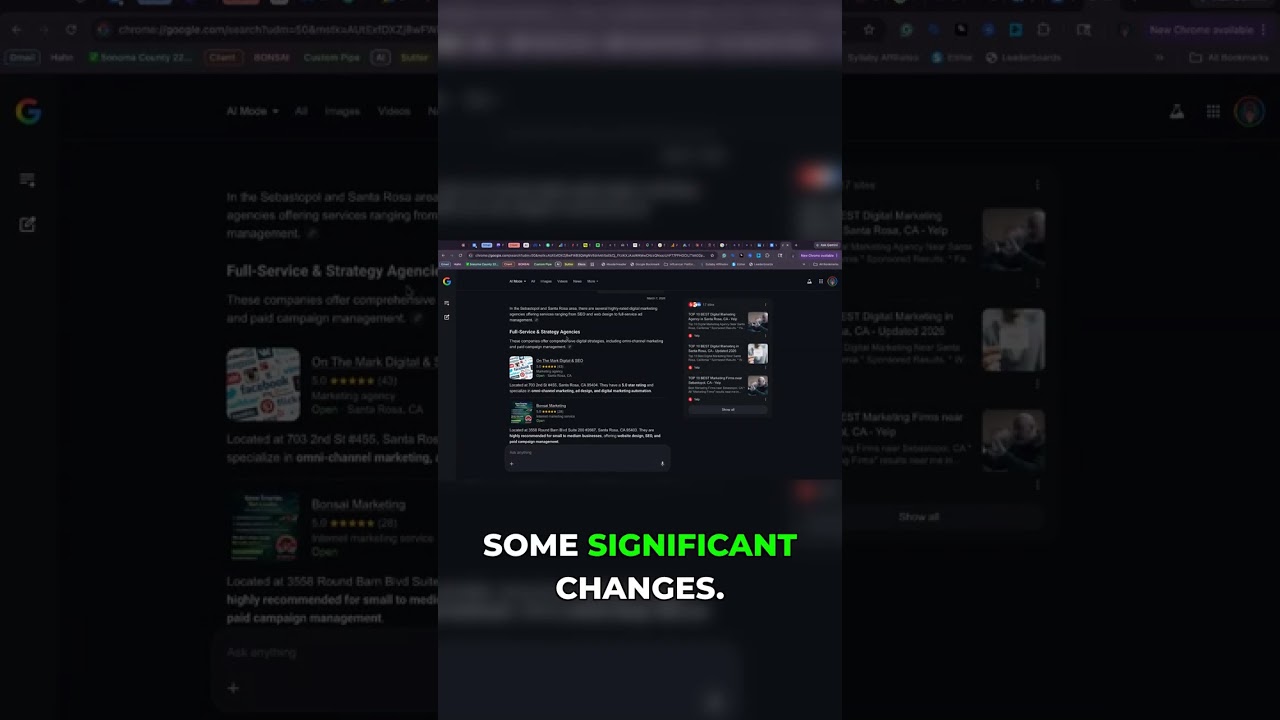
So there's companies that have been here for however long doing this thing. So here I am. I'm typing in digital marketing companies near me and you're going to see that Google's made some significant changes. They're starting to use the AI model for search results.
But here I am, Bonzai Marketing. I'm ahead of, you know, 73 reviews. I've got less reviews. I mean, it like all I had to do was focus and put a lens on it and it's like I'm back.
Auto-generated from the video · 85 words
Google's AI search results just reshuffled the rankings — and Bonsai Marketing climbed to the top with fewer reviews than competitors. Here's what that means for your visibility strategy.
Google's shift to AI-powered search results is actively changing which businesses appear at the top — and most marketers haven't adjusted yet.
Having more reviews no longer guarantees top placement; focused optimization now outweighs raw review count.
Bryan Fikes demonstrated live that Bonsai Marketing ranked above established competitors for 'digital marketing companies near me' despite having fewer reviews.
The businesses winning in AI search are the ones that put a deliberate lens on their local visibility — not the ones who've simply been around the longest.
Showing up in AI-generated search results requires a different strategy than traditional SEO, and the window to act early is open right now.
Google just changed the rules, and most marketing companies are still playing the old game.
In this video, Bryan Fikes pulls up a live search — digital marketing companies near me — and shows exactly what’s happening in real time. Google’s AI model is now shaping search results in a way that breaks the old assumptions. Businesses that have been around for years, stacked with reviews, are no longer guaranteed top placement. And Bonsai Marketing, with fewer reviews than several competitors, is sitting right at the top.
That’s not luck. That’s what focused optimization looks like when it’s aimed at the right target.
The Review Count Myth
For years, local SEO ran on a simple formula: more reviews meant more authority, and more authority meant better rankings. That formula is breaking down.
AI-driven search results don’t just tally up stars and count citations. They evaluate your entire digital presence — how your content is structured, how clearly you communicate what you do, how consistently your information appears across the web. A business with 73 reviews can lose ground to one with fewer if that smaller competitor has a sharper, more coherent signal.
Bryan’s live demonstration makes this impossible to ignore. It happened right there in the search bar.
What AI Search Actually Rewards
Engines like Google AI Overviews, ChatGPT, Perplexity, and Gemini are all pulling from the same fundamental principle: they surface sources they can trust to give a clear, accurate answer. That means the businesses showing up aren’t just optimized for keywords — they’re optimized to be cited.
That’s a meaningful distinction. Traditional SEO got you a blue link. AI search optimization gets you named as the answer.
The Shift Most Businesses Are Missing
The companies that have been around the longest tend to be the most complacent. They built visibility under the old model and haven’t had a reason to rethink it — until now. That complacency is exactly the opening that focused businesses can walk through.
Bryan’s point in the video is straightforward: he put a lens on it. He stopped assuming the old work was enough and started optimizing for where search is actually going. The result was immediate and visible.
This is the window. AI search is still early enough that first-movers are earning positions that will be much harder to claim once the rest of the market catches up.
What You Should Be Doing Right Now
If your local search visibility hasn’t been audited against AI search behavior, you’re operating on outdated intelligence. A few things worth examining:
- How your business is described across every platform and whether that description is consistent and clear enough for an AI engine to summarize confidently
- Whether your content answers real questions directly, or just exists to check a box
- How you appear — or whether you appear at all — when someone asks ChatGPT, Perplexity, or Gemini about businesses like yours in your market
None of this requires starting over. It requires a focused reset aimed at the right signals.
The businesses that understand this shift now will own their category in AI search. The ones that wait will spend next year trying to catch up to whoever moved first.
Answered.
How is Google's AI changing local search results? +
Google is now using AI models to generate and rank search results, which changes the signals that determine who appears at the top. Factors like review count matter less than they used to when your overall presence is properly optimized.
Can a business with fewer reviews outrank one with more reviews in AI search? +
Yes. Bryan Fikes showed this live — Bonsai Marketing ranked above competitors with significantly more reviews by focusing on the right optimization signals rather than chasing review volume alone.
What does it take to rank in Google's AI-powered search results? +
It takes focused, intentional optimization built around how AI engines evaluate and surface local businesses. Longevity and review count alone won't carry you anymore.
Is it too late to adjust my strategy for AI search? +
No — most businesses haven't made this shift yet, which means the opportunity to establish early visibility is still very much available.
What is Google AI Overviews and why does it matter for local businesses? +
Google AI Overviews is the AI-generated answer layer appearing at the top of search results. If your business isn't optimized to be cited there, you're invisible to a growing share of searchers — regardless of how long you've been in business.