
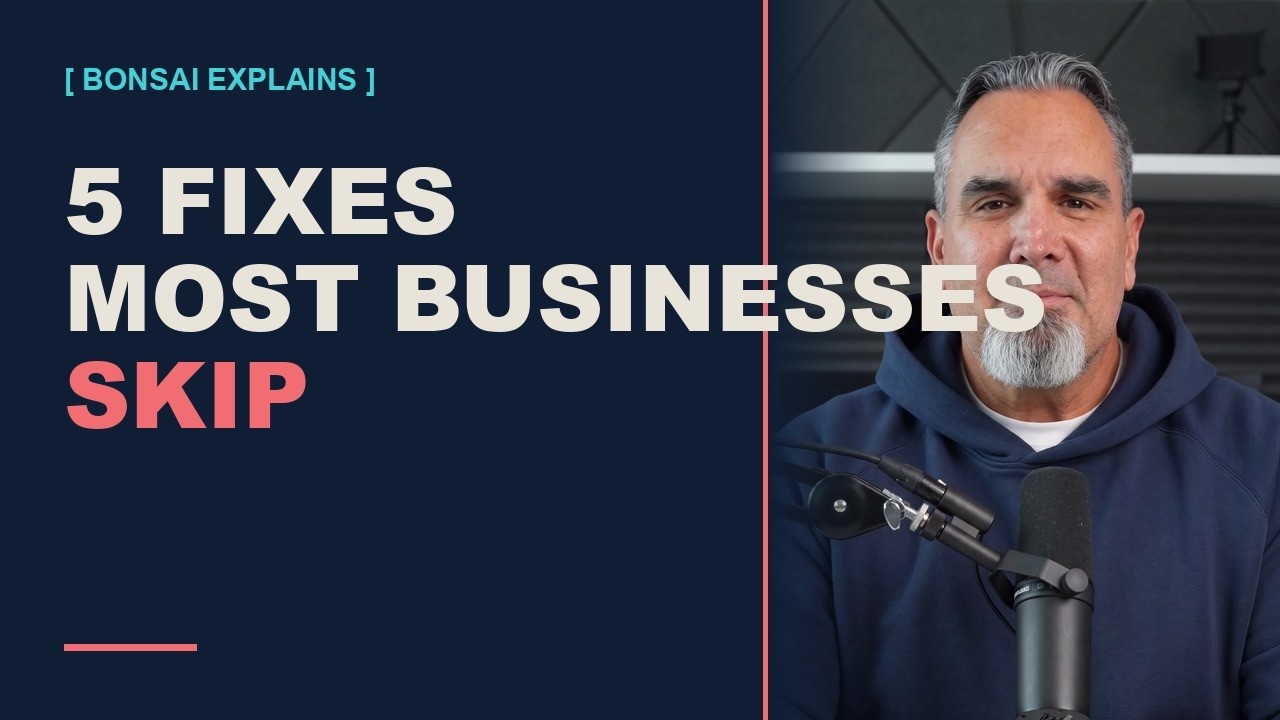
The 5 Google Business Profile Fixes That Actually Move Rankings
Your Google Business Profile is not a listing anymore — it is the authoritative database record AI engines use to decide if your business is real and relevant. Five specific fixes determine whether you show up or get skipped.
Your Google Business Profile is not a listing anymore — it is the authoritative database record AI engines use to decide if your business is real and relevant. Five specific fixes determine whether you show up or get skipped.
Primary category is the single highest-leverage field on your entire profile — approximately right means invisible to Google.
The services section is free real estate that feeds AI engines directly, and most businesses leave it blank or half-filled.
Replying to reviews generates fresh, dated, keyword-rich text you control — unanswered reviews are dead ends and missed trust signals.
Photos dated this year signal to both humans and machines that your business is active and credible.
Exact name, address, and phone consistency across your profile, website, and directories is the unglamorous fix that quietly breaks everything else when ignored.
Most local businesses have spent years building a website, running ads, and posting on social media — while leaving their single most authoritative digital asset almost completely unattended. Your Google Business Profile is not a listing. It is a structured database record that Google and every major AI engine treats as the definitive statement of what your business is, where it operates, and whether it deserves to be recommended.
That distinction has consequences.
Your Profile Wins the Conflict
When your website and your profile say different things, the profile usually wins. It is verified. It is structured. It is easier for a machine to parse and trust. Your website is where you do your marketing. Your profile is where you establish your identity. If you have been neglecting it, you have been arguing with yourself — and losing.
This dynamic only intensified when AI assistants entered the picture. The assumption was that AI would make local listings less relevant. The opposite is true. When someone asks ChatGPT, Gemini, or Perplexity for a reliable contractor nearby, those systems reach for structured, verified, local data they can trust. A thin or contradictory profile does not get a second look. It simply does not qualify.
The Five Fixes, In Order
These are the five areas addressed in every profile audit, in the exact sequence they matter.
Primary category is the highest-leverage field on the entire profile. Google uses it to determine which searches your business is even eligible to appear in. A roofing contractor categorized as a construction company is not close enough — it is invisible to the searches that matter. Approximately right is not right.
Services is free real estate that most businesses leave blank. Every service you actually sell should be listed with a plain-language description. This section feeds directly into what AI engines can say about your business when someone asks.
Review replies matter more than most businesses realize — and not for the reasons they think. Getting more reviews is valuable, but replying to the ones you already have generates fresh, dated, keyword-rich text that you control, attached to a verified and trusted source. An unanswered review is a dead end. A thoughtful reply is an active signal. Businesses sitting on 200 unanswered reviews have left 200 indexable conversations on the table.
Photos from this year send a freshness signal. Old photos read as a business that might not be open anymore — to humans and to machines. Current photos are a low-effort trust signal with a real impact.
Consistency is the unglamorous fix that quietly undermines everything else. Your business name, address, and phone number must match exactly across your profile, your website, and every directory listing. Suite numbers, abbreviations, phone formatting — all of it. Inconsistency teaches machines to doubt you.
Start With One Field
Open your profile right now and check your primary category. One field. If the words do not exactly match how you would describe what your business does, change it today and watch what happens over the next three weeks.
This is not a tactic or a workaround. It is maintenance. The businesses that own their local market are not doing anything secret — they are doing the obvious thing consistently, on purpose, every quarter, while their competitors rely on a profile they set up years ago and never revisited.
As AI search continues to pull from structured data sources to answer local queries, the quality of your profile will determine whether you are a credible answer or an invisible option.
Answered.
What is the most important field on a Google Business Profile? +
Primary category. Google uses it to determine which searches your business is eligible to appear in. Being close to right is not good enough — it needs to be exact.
Why do Google Business Profiles matter more in the AI era? +
When someone asks an AI assistant for a local recommendation, that system pulls from structured, verified data sources. Your Google Business Profile is that data. A thin or inconsistent profile means you are not a candidate for those answers.
How do review replies help local search rankings? +
A reply adds fresh, dated, keyword-rich text attached to a trusted, verified source. Businesses sitting on hundreds of unanswered reviews are leaving hundreds of indexable signals on the table.
How often should a Google Business Profile be updated? +
At minimum every quarter. Businesses that dominate local search treat their profile as active infrastructure, not a one-time setup. Most competitors set it once and never return.
Does my Google Business Profile or my website carry more authority with Google? +
When there is a conflict between the two, your profile usually wins. It is structured, verified, and easier for machines to trust. Your website is your marketing — your profile is your identity.