Stop Writing Giant AI Prompts
Bigger prompts don't mean better output. Learn the 4-part mission framework that gets stronger results from modern AI — without writing a word of procedure.
Bigger prompts don't mean better output. Learn the 4-part mission framework that gets stronger results from modern AI — without writing a word of procedure.
Modern AI models like GPT-4o and Gemini 1.5 are trained to infer procedure — your job is to define the destination, not map every step.
The 4-part framework — Objective, Success, Authoritative Context, and Constraints — replaces instruction-writing with mission-writing.
Objective means the business outcome you need, not a description of the task you want the AI to perform.
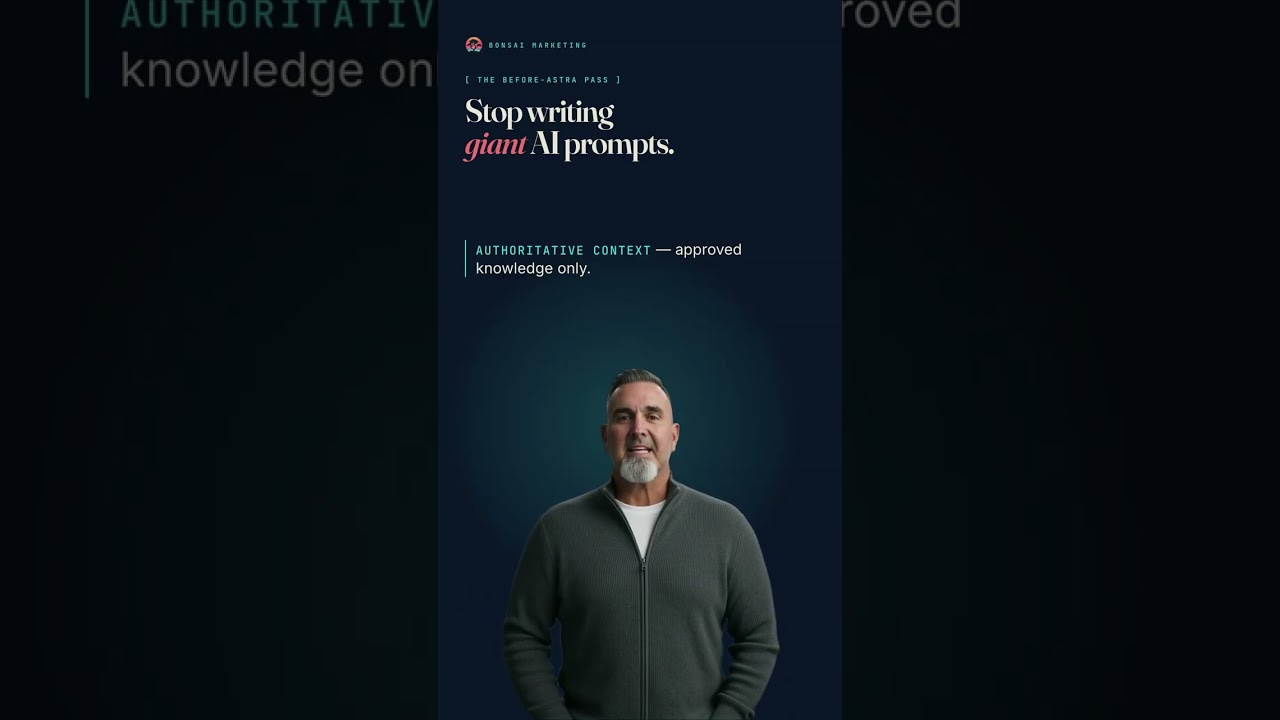
Authoritative context means approved, verified knowledge only — no invented sources, no hallucinated citations slipping into your output.
Constraints aren't limitations, they're production guardrails: no unsupported claims, simplest reliable path, nothing that can't be defended.
Most businesses are still treating AI like a junior employee who needs every step spelled out. That instinct made sense in 2023. It’s costing you quality in 2025.
The reflex to write exhaustive, procedural prompts — sometimes running 2,000 to 3,000 words — comes from a reasonable place. Early models needed guardrails. They needed you to anticipate failure points and plug every gap in advance. But the models available now are fundamentally different. They reason. They infer. And when you over-specify procedure, you get in their way.
The Problem With Procedural Prompting
When you write a prompt that reads like a standard operating procedure, you’re not guiding the model — you’re constraining it. You’re replacing its judgment with your assumptions about how the work should flow. In most cases, your assumptions are less sophisticated than what the model would do on its own if you simply told it what success looks like.
The result is output that follows your script instead of solving your problem. That’s a meaningful difference.
The 4-Part Mission Framework
At Bonsai Marketing, we stopped writing instructions. We write missions. Every prompt we build has four components:
Objective — This is the business outcome, not the task. Not “write a blog post about local SEO” but “generate a piece that positions this firm as the go-to authority on restaurant marketing in Phoenix.” The model needs to know where you’re going, not what you’re doing.
Success — What has to be true when the work is done? Define the finish line in concrete terms. This gives the model a standard to work toward and gives you a clear way to evaluate what comes back.
Authoritative Context — Feed the model what it’s allowed to use: approved knowledge, verified sources, your actual expertise and positioning. Nothing invented. This is where you prevent hallucinations before they start, not after.
Constraints — These are production guardrails, not creative restrictions. No unsupported claims. Simplest reliable path. Constraints don’t limit the output — they protect its integrity.
Why This Works Across Every Major AI Engine
This framework isn’t built for one platform. It produces strong results in ChatGPT, Gemini, Claude, Perplexity, and AI Overviews — and it’s already positioned for where models like GPT-6 and Astra are heading. The direction of AI development is toward more autonomous reasoning, not less. Prompts that define outcomes will keep working. Prompts that define procedures will keep fighting the model.
Mission-Writing Is a Strategic Skill
There’s a broader point here that goes beyond prompting technique. The businesses that get the most from AI aren’t the ones writing the longest prompts — they’re the ones who have done the strategic work to know what they actually need. Clear objective. Defined success criteria. Verified knowledge base. Tight guardrails.
That clarity doesn’t come from knowing AI. It comes from knowing your business.
When you write a mission instead of a procedure, you’re also forcing yourself to answer a harder question: what does winning actually look like here? That question improves your thinking before the AI is even involved.
The 3,000-word prompt is a 2025 relic. The teams building real advantages right now are the ones who’ve learned to say less — and mean more.
Answered.
Why are long AI prompts becoming less effective? +
Newer models are trained to reason through procedure on their own. When you over-specify steps, you constrain the model's reasoning and often produce weaker output than a clear, outcome-focused prompt would.
What is the 4-part AI prompt framework from Bonsai Marketing? +
The framework has four components: Objective (the business outcome, not the task), Success (what must be true when the work is done), Authoritative Context (verified knowledge, no invented sources), and Constraints (guardrails like no unsupported claims and simplest reliable path).
What is the difference between writing instructions and writing missions for AI? +
Instructions tell the AI how to do something step by step. Missions tell the AI what winning looks like. Mission-based prompts give modern models room to apply their reasoning, which produces more reliable and higher-quality output.
How do constraints improve AI output quality? +
Constraints protect the production value of the output. Rules like no unsupported claims and take the simplest reliable path prevent the model from filling gaps with fabricated information or overcomplicating a response.
Does this prompt framework work with ChatGPT, Gemini, and other AI engines? +
Yes. The Objective-Success-Context-Constraints structure is model-agnostic and works across ChatGPT, Gemini, Claude, Perplexity, and emerging models like GPT-6 and Astra.