Stop Prompting AI Like It's 2025: The New Way to Use GPT-6 Astra
Three years of prompt engineering trained us to do the model's thinking for it. GPT-6 Astra changed the economics — here's the four-part mission prompt and the verification pass that replaced our 3,000-word instruction manuals.
▤ Video transcript Show + Hide -
If you're still writing three-thousand-word instruction manuals to get an answer out of the newest AI models, you might actually be making them worse. The smarter these systems get, the less they need you to micromanage every step — and the more they need you to define the outcome. I'm Bryan Fikes, founder of Bonsai Marketing Company. Let's talk about what actually changed. For three years we all trained ourselves to compensate for weaker models.
Do this first. Then this. Format it exactly like that. Never do this. Here are nine examples.
Here's a persona, a tone guide, a checklist, and a fallback plan. It worked — because the model couldn't hold the whole problem in its head. So we held it for them. That was prompt engineering. It was scaffolding for a system that wasn't strong enough to stand on its own.
On September third, twenty twenty-six, OpenAI released GPT-6 Astra. Roughly a million tokens of context, and a model built to operate software — browse, inspect a screen, run checks, work through a real task instead of answering a question about it. Here's what that changes in practice. When the model can hold the whole problem and choose its own path, the scaffolding stops helping and starts getting in the way. Every step you prescribe is a step it can no longer optimize.
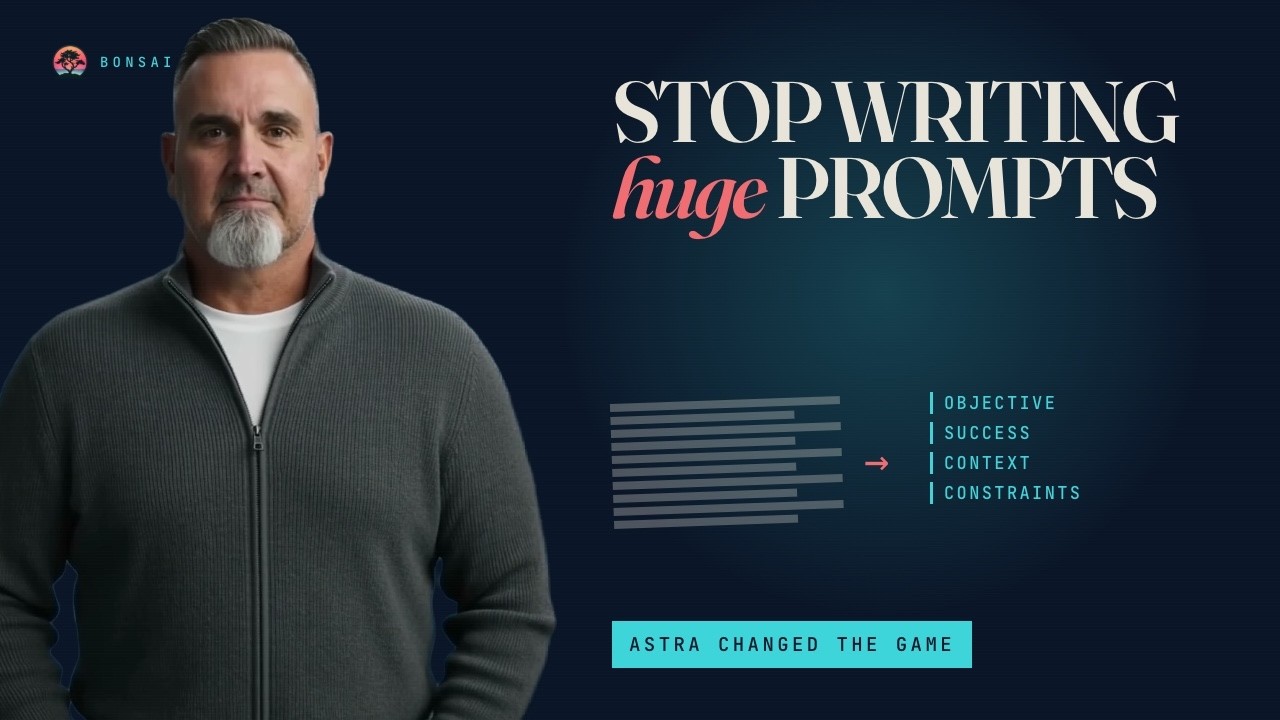
So we rebuilt how we prompt. We call it the Before-Astra pass, and it has four parts. Objective — the business outcome, not the task. Success — what has to be true when it's done. Authoritative context — approved knowledge, verified sources, nothing invented.
And constraints — protect production, protect secrets, no unsupported claims, take the simplest reliable path. That's it. No procedure. We stopped writing instructions and started writing missions. Here's what that looks like for a real client.
A roofing company in Sonoma County. The old way was a task list. Research ten competitors. Find twenty keywords. Write five city pages.
Optimize the headings. Build the schema. Check the Business Profile. Run QA. Every one of those is a guess about the right method, written by someone who hasn't looked at the data yet.
The new way is one paragraph. Objective: become the strongest locally relevant roofing search asset in the county, and generate qualified calls. Success: accurate service and city coverage, technically sound local SEO, a real Business Profile strategy, strong entity signals for AI search, production-ready pages, verified tracking. Knowledge: our approved services, service area, proof, offers, reviews. Constraints: no invented locations, no unsupported claims, nothing destructive in production.
Then you let it determine the plan. And the plan it builds is usually better than the checklist I would have written, because it's built after looking at the data instead of before. Now — autonomy without verification is just a new way to fail. So there's a second pass. After Astra.
Did it actually achieve the objective? What's still incomplete? Are the claims factual, or plausible? Is the implementation real, or described? Were meaningful tests actually run?
Is this production-ready? And it reports back in four lines. Delivered. Verified. Exceptions.
Next best action. That verification pass is not optional. It's the thing that makes the autonomy safe to use. This is why we've been knowledge-first at Bonsai from the start. Discover.
Verify. Structure. Approve. Build. Deploy.
Improve. Because here's the part most people are going to miss: the better the model gets, the more valuable your trusted business knowledge becomes. A stronger model doesn't reduce your need for accurate, approved, structured information about your business. It multiplies it. The knowledge base becomes the truth.
The prompt becomes the mission. The future of this isn't longer prompts. It's giving an intelligent system the right knowledge, a clear outcome, and the authority to solve the problem — and then verifying what came back. That's how we're building at Bonsai Marketing Company. If you're trying to turn AI from a chatbot into an operating system for your business, come find us at bonsaimarketingcompany.com.
Auto-generated from the video · 669 words
Three years of prompt engineering trained us to do the model's thinking for it. GPT-6 Astra changed the economics — here's the four-part mission prompt and the verification pass that replaced our 3,000-word instruction manuals.
Prompt engineering was scaffolding for models that couldn't hold a whole problem in context. Once the model can, every step you prescribe is a step it can no longer optimize.
The Before-Astra prompt has four parts and no procedure: objective, success criteria, authoritative context, and constraints.
The After-Astra pass assumes the work is wrong — did it achieve the objective, are the claims factual or merely plausible, is the implementation real or only described, were meaningful tests actually run.
Autonomy without verification is not an upgrade; it is a new failure mode that produces confident, well-formatted, completely wrong work.
A stronger model multiplies rather than reduces the value of accurate, approved business knowledge — it is now good enough to act fast on whatever you give it, including the wrong things.
Answered.
Does this mean prompt engineering is dead? +
No — it means the scaffolding half of it is. Defining an outcome, the success criteria and the constraints precisely is still skilled work. What stops paying is dictating the procedure to a model that can plan better than your template can.
What actually changed with GPT-6 Astra? +
Roughly a million tokens of context and a model built to operate software — browse, inspect a screen, run checks and work through a real task rather than answer a question about it. Those are OpenAI's published product facts; the Before-Astra / After-Astra framework is Bonsai Marketing's own operating practice, not an OpenAI recommendation.
Why does a better model make my business knowledge more valuable? +
Because the model will now act on what you give it, quickly and competently. Accurate, approved, structured facts about your business become the constraint on output quality. The knowledge base becomes the truth and the prompt becomes the mission.