Is AI Recommending Your Competitor?
When a Sonoma County customer asks an AI assistant for a recommendation, one business gets named — and it is not always the best one. It is the one the model can find, verify, and trust. Here is what AI visibility actually measures, and how to see where you stand.
▤ Video transcript Show + Hide -
Are you confident that your business is being recommended over your competitors by AI assistants? In today's digital landscape, understanding your visibility through AI tools is crucial for success — especially for service businesses in Sonoma County.
Let's dive into what AI visibility really means for your business. AI visibility is how easily AI assistants can find and recommend your business over others.
Local visibility is essential for service businesses, as it directly impacts customers and sales. Our AI Visibility Report provides insights on how your business compares to competitors.
Hear from local businesses that have transformed their visibility using our report. Don't leave your visibility to chance — get your free AI Visibility Report today and take control of your business's future.
Auto-generated from the video · words
When a Sonoma County customer asks an AI assistant for a recommendation, one business gets named — and it is not always the best one. It is the one the model can find, verify, and trust. Here is what AI visibility actually measures, and how to see where you stand.
AI visibility is how easily an AI assistant can find, verify, and recommend your business over a competitor — it is not the same thing as ranking on Google.
For a service business, the recommendation is the sale. When an assistant names one local provider, the other options are not compared unfavorably — they are never seen.
Local visibility compounds. The businesses AI engines already trust get cited more often, which reinforces that trust and widens the gap on its own.
You cannot fix what you have not measured. The first step is auditing what AI engines say today when someone asks for a business like yours.
There is a question worth asking before the next marketing dollar goes out the door: when someone in Sonoma County asks an AI assistant to recommend a business like yours, what name comes back?
For a growing share of customers, that is now the entire search. They do not scan ten results and form an opinion. They ask, they get one or two names, and they call. The comparison step local businesses have spent two decades optimizing for is quietly disappearing.
Visibility Is Not the Same as Ranking
It is tempting to assume that ranking well on Google means being visible to AI. It does not follow. An assistant is not sorting a list — it is assembling an answer, and it will only name a business it can find, verify, and trust enough to stake a recommendation on.
That last part is where most local businesses lose. The information exists, but it is inconsistent across the web, thin on the details that establish credibility, or absent from the sources the engines actually read. The business is findable. It is simply not citable.
The Recommendation Is the Shortlist
In classic search, being second costs you some traffic. In an AI answer, being second frequently means not appearing at all. There is no page two. When the assistant names one provider, the alternatives are not compared unfavorably — they are never surfaced.
For a service business, where a single job can be worth thousands, that asymmetry is the whole argument for taking AI visibility seriously now rather than later.
It Compounds in One Direction
The businesses AI engines already trust get cited more often. Being cited more often reinforces that trust. The gap between the recommended business and the invisible one widens on its own, without either party doing anything differently.
Which is the real reason this is urgent — not because AI search is new, but because the advantage accrues to whoever establishes it first, and it gets more expensive to close the longer it is left alone.
Start by Measuring It
None of this is fixable by guessing. The first move is to find out what the engines currently say when someone asks for a business like yours — which questions surface you, which surface a competitor, and what specifically is driving the difference.
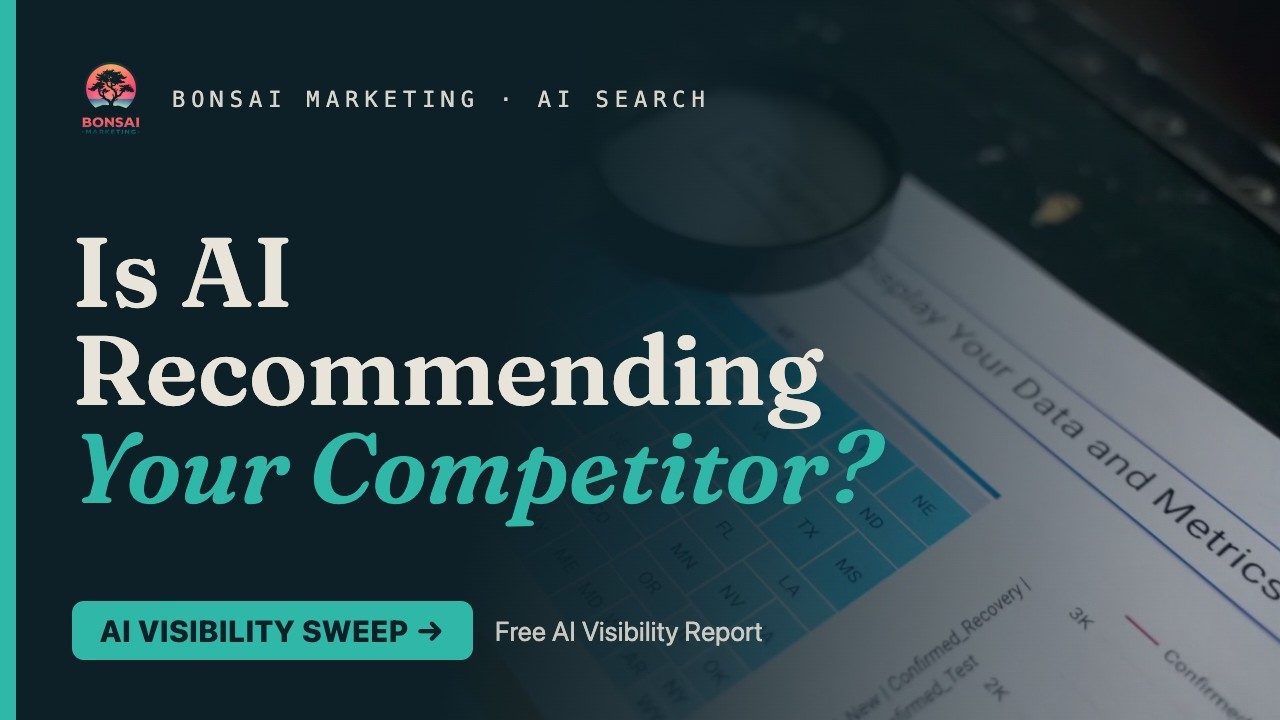
That is what the free AI Visibility Report does. It is a baseline, not a pitch: where you appear today across the major AI engines, who is being recommended instead, and the concrete signals behind it.
You cannot control what you have never looked at. Start by looking.
Answered.
What is AI visibility, and how is it different from SEO? +
Traditional SEO is about ranking a page in a list of links. AI visibility is about whether an assistant names your business when someone asks for a recommendation. There is no page two in an AI answer — either you are cited or you are absent, which makes the gap between first and second far more expensive than it is in classic search.
Why does this matter more for a local service business? +
Because the query is almost always high-intent. Someone asking an assistant for a roofer, an electrician, or a dentist in Sonoma County is close to buying. When the assistant names one provider, the customer usually does not go looking for alternatives — the recommendation is the shortlist.
How do I find out whether AI engines currently recommend my business? +
Audit it directly. Ask the engines the questions your customers ask — across ChatGPT, Google AI Overviews, Perplexity, and Gemini — and record who gets named. That baseline is what the free AI Visibility Report produces: where you appear, where a competitor appears instead, and what is driving the difference.
Can a smaller business realistically compete here? +
Yes, and often more easily than in paid search. AI engines weight credibility signals — consistent business information, real reviews, clear service and location pages, third-party corroboration — rather than ad budget. A well-structured small business can be recommended over a larger competitor that has never addressed any of it.