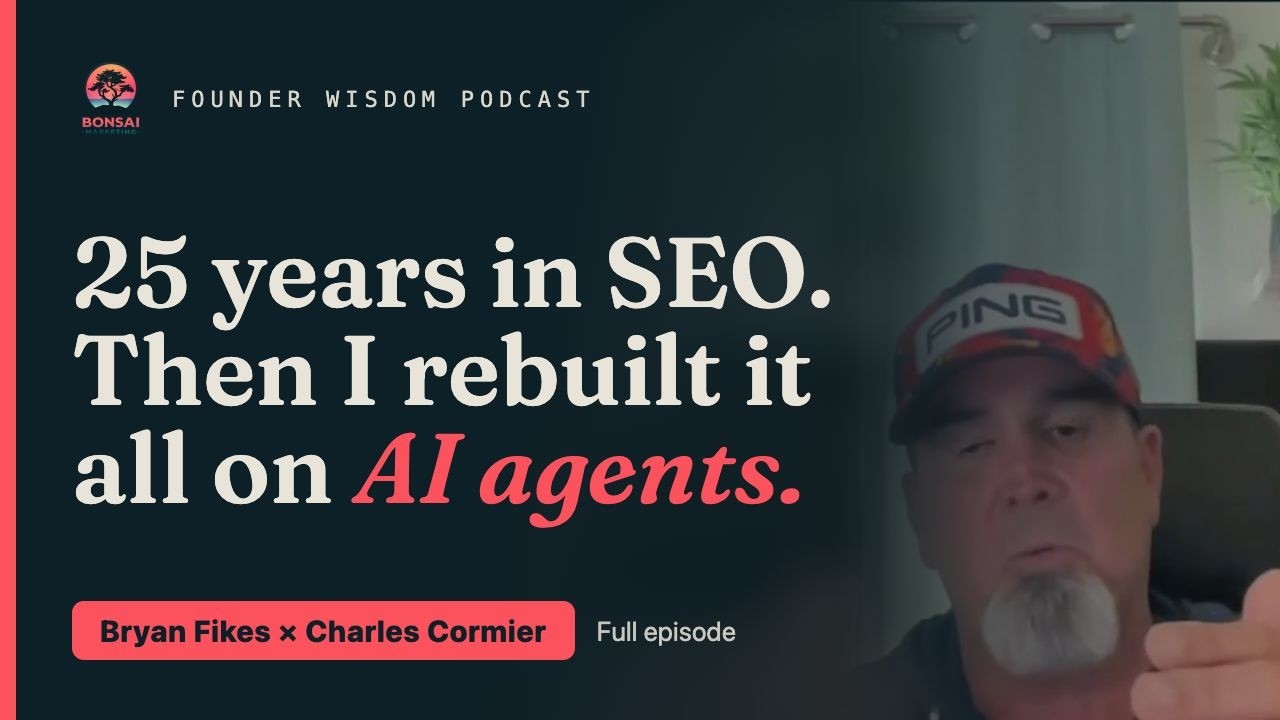
25 Years in SEO, Then I Rebuilt My Agency on AI Agents — Founder Wisdom Podcast with Charles Cormier
Bryan Fikes built and sold an SEO agency, survived Google wiping out his income twice, and rebuilt from scratch on AI agents — here's what 25 years in search actually teaches you.
Bryan Fikes built and sold an SEO agency, survived Google wiping out his income twice, and rebuilt from scratch on AI agents — here's what 25 years in search actually teaches you.
Hyper-local SEO as a distinct discipline was being practiced as early as 2003 — Bryan called it geoloc before the term existed, working with HVAC brands and celebrity clients.
Scaling an agency too fast without airtight processes creates a paper mill where 30% delivery efficiency feels like a win — and that slow rot is harder to recover from than a sudden crash.
Google has reset Bryan's business more than once, and each reset confirmed the same truth: telling a story correctly for the right audience is the job, whether the delivery mechanism is a search engine or an AI platform.
A near-death health scare in his early fifties became the catalyst that brought Bryan back — not nostalgia, not boredom, but a deliberate decision to build something he could be proud of this time.
Building an AI-agent-powered agency from the ground up is an advantage the legacy shops with 200 employees cannot easily replicate — the freedom to start clean is worth more than inherited infrastructure.
Bryan Fikes started in search before anyone called it SEO. That context matters — because everything he has built, lost, and rebuilt since 2000 carries a clarity that only comes from watching an entire industry invent itself around you.
From Sole Prop to Agency to Paper Mill
The first business was Zenergy Internet Marketing, a sole proprietorship that grew through a partnership into Zenergy Works. Bryan describes the dynamic plainly: he was the gas pedal, his partner was the brake. That balance worked — until the agency scaled past the point where Bryan’s original vision could survive the telephone game.
“By the time it got out to the rest of the team, it was Sarah in a yellow Miata on Tuesday,” he said, describing a strategy that left his desk one way and arrived at execution looking like something else entirely.
The agency became a paper mill. Clients were being served, but the work didn’t match the standard Bryan held in his head. That gap — between what he sold and what got delivered — wore him down in ways that took years to fully surface.
Google Resets and What They Actually Teach You
Bryan has had his income wiped out by Google more than once. Ad arbitrage that generated real wealth in 2018 and 2019 disappeared when the algorithm shifted. He describes waking up to a world that said start over — and doing exactly that, without drama.
What he holds onto through each reset is a principle he has carried since 2003, when he was doing what he now calls geoloc SEO with HVAC brands and celebrity clients: the goal is always to tell a story correctly and get it in front of the right person. The delivery mechanism changes. The core job does not.
That frame applies as cleanly to ChatGPT and Perplexity today as it did to early Google two decades ago.
The Semi-Retired Years and the Health Scare
After selling Zenergy Works, Bryan entered what he calls a semi-retired life. A Google revenue stream that grew steadily gave him the freedom to travel, golf, and step away from the pressure of managing a large team. He describes it as comfort — but comfort without direction.
Then a health crisis nearly ended everything. A doctor told him he had roughly a day. Four months of recovery followed.
That period became the reset point. Not a business pivot driven by market trends, but a personal reckoning that forced the question: what do I actually want to build, and can I build it right this time?
Building the AI-Agent Agency
The answer Bryan arrived at was an agency structured around AI agents — systems that handle the execution layer so that his vision doesn’t have to survive a telephone game to reach the client.
He had been watching AI tools evolve for four years before committing. Early tools like Jasper and Copy.ai gave him a read on where things were heading. Vibe coding and agent frameworks showed him what was now possible for a solo operator with deep domain knowledge and no legacy infrastructure to protect.
“I can take all the parts of my brain and how it works” — that’s how he frames the appeal. The agents don’t dilute the strategy. They execute it.
Why Legacy Shops Are at a Disadvantage
Large agencies with hundreds of employees face a genuine structural problem. Integrating AI into an organization built on human labor and departmental hierarchy is a slow, expensive process. Bryan built around that constraint by starting clean — no inherited processes, no department heads to retrain, no sunk cost in the old model.
For boutique operators who have the domain expertise and the willingness to rebuild, this moment is a structural opening. The agencies that move now, and move deliberately, will be setting the standard before the larger shops finish their internal debates.
Twenty-five years in, the fundamentals have not changed. What has changed is who gets to win.
Answered.
Who is Bryan Fikes and what is his background in SEO? +
Bryan Fikes began working in search in 2000, before the industry had a name for it. He founded Zenergy Works, grew it into a multi-client agency, sold it, and spent years in semi-retirement before rebuilding under the Bonsai Marketing brand powered by AI agents.
What is geoloc SEO and did Bryan Fikes pioneer it? +
Geoloc SEO is the practice of optimizing content and presence for specific geographic searches. Bryan was executing this strategy around 2003, working with large HVAC brands and celebrity clients — years before local SEO became standard agency practice.
How has Bryan Fikes rebuilt his agency using AI agents? +
Rather than rehiring staff, Bryan used AI tools to automate the execution layer of his agency — research, content, and workflows — building a leaner operation that delivers more consistent output than the team-dependent model he ran before.
What lessons did Bryan Fikes learn from scaling and selling his first agency? +
The biggest lesson was that fast growth without tight processes turns an agency into a telephone game. By the time a campaign strategy reached the execution team, the original intent was lost. He now builds systems where the vision and the output stay connected.
Why is AI an advantage for boutique agencies over large legacy shops? +
Large agencies have to unwind department heads, retrain teams, and redesign org charts to integrate AI. A smaller, rebuilt-from-scratch operation can wire AI into every layer from day one — which is exactly what Bryan did with Bonsai Marketing.