
"Back in 24 hours."
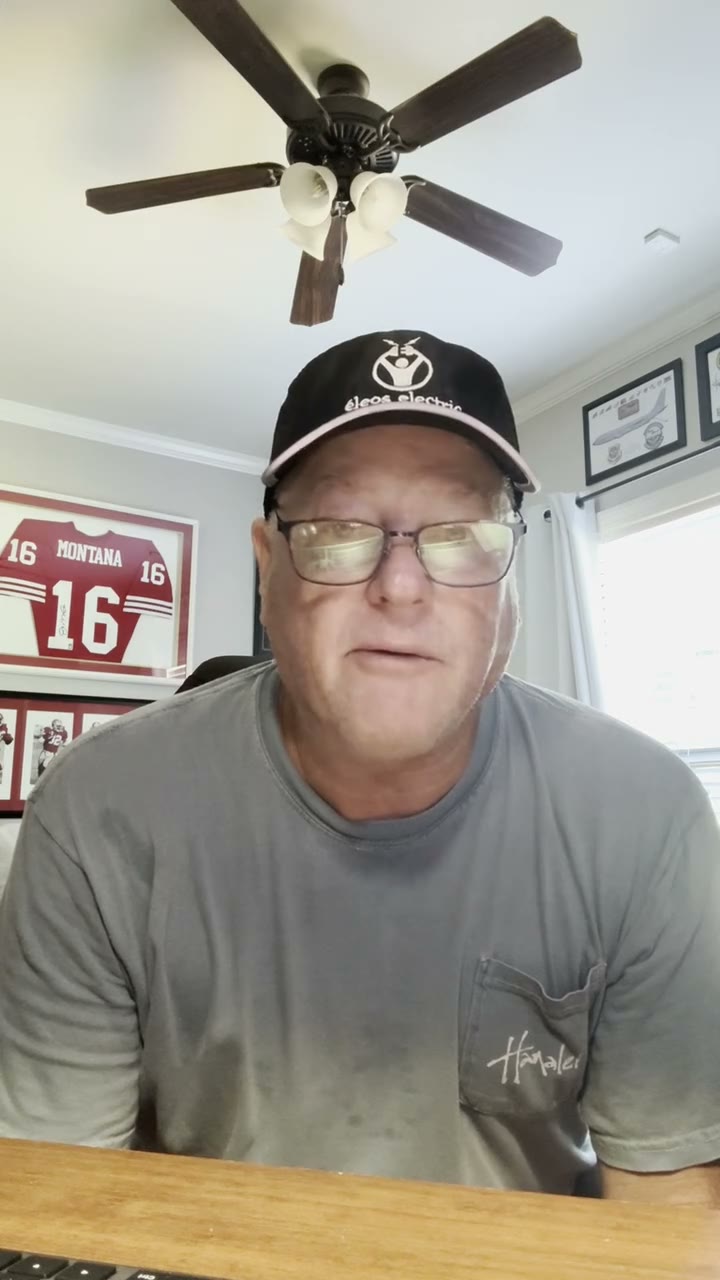
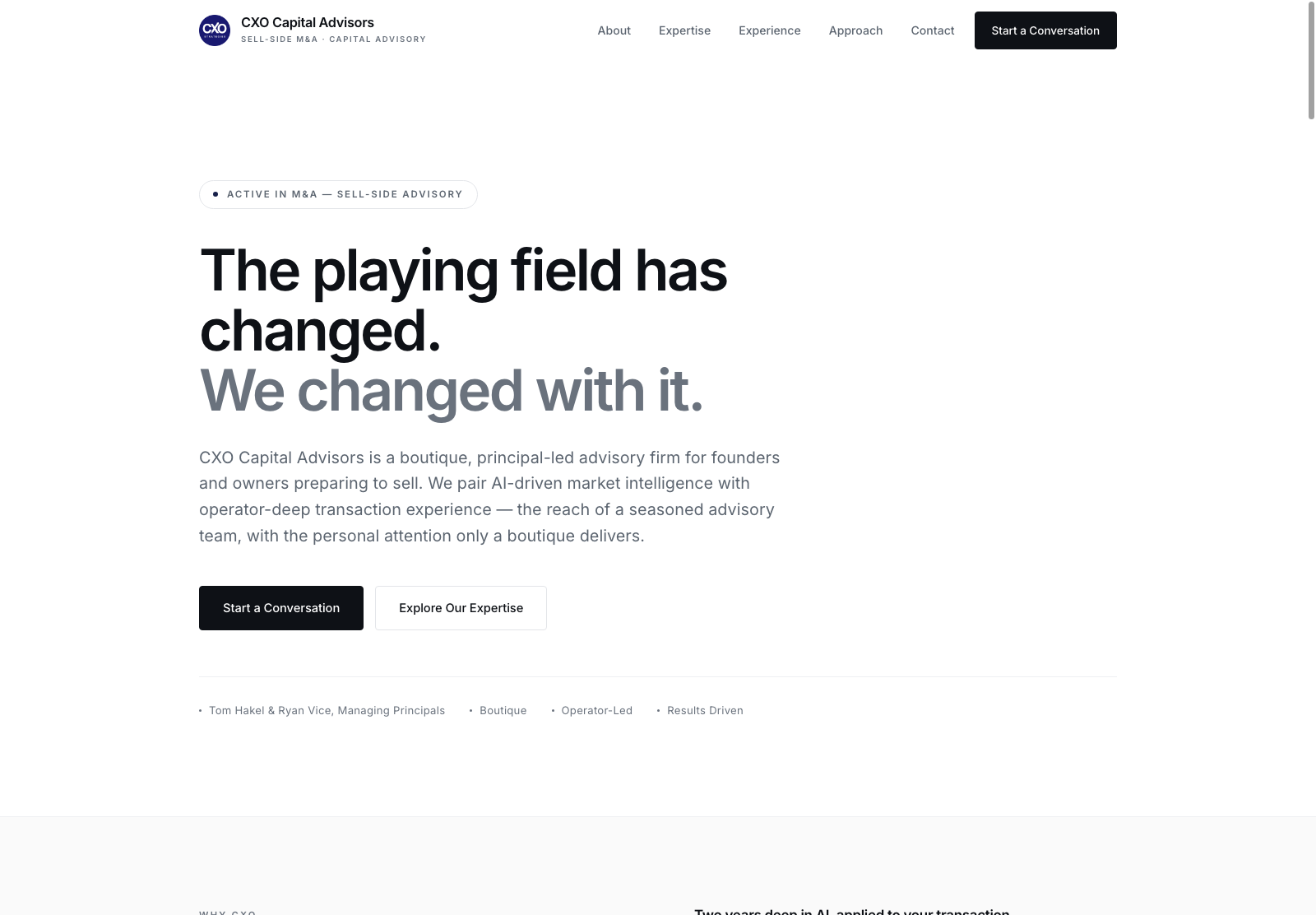
Tom Hakel and Ryan Vice spent about a year standing up a sell-side M&A practice — the licensing, the broker-dealer affiliation, the compliance apparatus. What they did not have on launch week was a website. This is Tom's account of what happened next, recorded at his desk with the site on the screen behind him.
"I sent it to Bryan, and literally a day later, I had a world-class looking website."
The moments
that matter.
"a year of work getting into it, getting licensed and all that"
The website was the last mile of a build that had been running for about a year. By the time it was needed, everything expensive and slow was already done — which is exactly when a slow website vendor becomes the constraint.
"literally a day later, I had a world-class looking website"
Turnaround measured against the client's own expectation, not against a project plan. Tom sent a one-page PDF and got a published site back the next day.
"Tells our story right. A lot of things I didn't even ask for"
Two separate things, and the second is the harder one. Getting the story right means the brief was read properly. Delivering past the brief means the gaps were filled without a round of questions Tom did not have time for.
"All the SEO, everything in there optimized"
Tom's read of what he received. What was actually built is listed under "What we delivered" below — schema, meta, sitemap, Search Console, analytics. No ranking or traffic claim appears on this page, because the site is weeks old and nothing has been measured yet.
Where they
started.
CXO Capital Advisors did not exist as a public entity until August 2026. Tom Hakel and Ryan Vice had spent roughly a year standing the practice up — the licensing, the broker-dealer affiliation through Finalis Securities, the compliance apparatus that has to be in place before anyone can represent a seller. The firm went live with two Managing Principals, a securities registration, and no website.
In sell-side M&A a website is less a lead-generation asset than a credibility instrument. A founder deciding who to trust with the sale of the company they built looks the firm up first, and what they find sets the tone for every conversation after it. A placeholder page would have undercut a year of work in the two seconds it takes to load.
What Tom had was a one-page PDF — positioning, both principals' backgrounds, the service model, a set of numbers — plus some ideas about how it should come together. What he needed was for that to become a real site fast enough to matter on launch week.
And the page carried a constraint most marketing sites do not: everything on it is subject to FINRA supervision through Finalis. Copy that overstates, a statistic without a basis, a legal entity name used loosely — those are compliance exposures, not editorial preferences.
What we
actually did.
The one-pager was the brief, and the only source
Every factual claim on cxoca.com traces to Tom's PDF. We kept a number-trace table through QA and held to it. The two figures that are not verbatim from the source are labelled on the page for what they are — one derived, one client-asserted — and a qualifier under the stat band notes that past experience is not a guarantee of future results.
Restraint was the design argument
Near-black on white, one deep navy accent, Inter throughout. No gradients, no stock photography, no logo wall, no glass. A founder evaluating a boutique firm is reading for judgment, and a page that shouts reads as a firm that needs to. Hierarchy and negative space carry the whole layout.
Instrumented before the domain was pointed
Organization and Person schema for the firm and both principals, canonical and social tags, sitemap, robots, GA4 and GTM, Search Console verification, TLS, security and cache headers, and a contact form routed to the firm — all wired at build time rather than bolted on after launch. The whole page is roughly one request beyond fonts.
We flagged the compliance error instead of quietly fixing it
The client-supplied disclosure named a different legal entity in one of its paragraphs. We raised it and changed nothing until Tom authorised the correction in writing. We also removed an alternate-name assertion from the schema that would have conflated two separate legal entities — precisely the confusion the disclosure exists to prevent. On a supervised page, that discipline is the job.
What
changed.
- "I sent it to Bryan, and literally a day later, I had a world-class looking website." — Tom Hakel, on camera
- "Tells our story right. A lot of things I didn't even ask for, and functionally works."
- "All the SEO, everything in there optimized — and I had it back in 24 hours. It's amazing."
- "We have a lot more work to do with Bonsai, but it's fantastic to have it."
- → cxoca.com live on 11 August 2026 — from a client one-pager to a published, instrumented site inside a day of build time.
- → Static build with inline CSS and JS: the page costs roughly one request beyond web fonts.
- → Organization and Person schema covering the firm and both Managing Principals, plus canonical, social, sitemap and robots.
- → GA4 and Google Tag Manager installed and firing; Search Console verified and the sitemap submitted.
- → Contact form live and routed to the firm, with a lead conversion event wired into GA4 and a privacy policy covering the analytics and form data the page actually collects.
- → Brand assets rebuilt from the source PDF: the logo recomposited from its RGB and soft-mask layers to restore transparency, both headshots extracted, and a 1200x630 social cover generated.
- → DNS cut over at the registrar without moving nameservers, so the firm's existing email kept running through the switch.
- → FINRA/Finalis disclosure reproduced verbatim, with its one internal entity-name inconsistency flagged to the client and amended only on written authority.
- ○ Higher-resolution headshots. The only originals available were 200x200 inside the source PDF — fine at the size they display, soft on a retina screen.
- ○ Capital formation as a named service. The registration covers M&A and capital raise, but the page leans sell-side because that is what the source one-pager documented. Adding it is a copy change that needs Tom's sign-off on the claim itself.
- ○ Ongoing search and AI-visibility work. Tom's own line — "we have a lot more work to do with Bonsai" — is accurate. This was a build, not a program. Nothing has been measured, which is why no ranking, traffic or lead number appears anywhere on this page.
- ○ Analytics ownership. GA4 and GTM sit in the Bonsai account because Google's API cannot create new client-side accounts, only properties inside existing ones. Both are movable to CXO whenever Tom wants to hold them himself.
0:34,
unedited.
Hey guys, I'm with Bryan now, and we just launched CXO Capital Advisors last week — a year of work getting into it, getting licensed and all that. We're very excited.
But I needed a website, and I had some ideas in a one-pager, and some ideas of how we were going to put it.
I sent it to Bryan, and literally a day later, I had a world-class looking website. It's right here. You can see it. It's fantastic.
Tells our story right. A lot of things I didn't even ask for, and functionally works. All the SEO, everything in there optimized — and I had it back in 24 hours. It's amazing.
We have a lot more work to do with Bonsai, but it's fantastic to have it.
Transcribed from the source recording. Only proper nouns were corrected for spelling — no wording was changed, added, or smoothed.
The part most
agencies skip.
The brief was already written
Tom did not arrive with a vague ambition; he arrived with a one-pager that had survived a year of compliance review. Everything a discovery process normally has to extract — positioning, credentials, service model, the numbers — was already decided and already defensible. Speed was possible because the thinking was done.
Speed came from the system, not from cutting
A day of build time is not a shortened version of a two-week build. It is a design system, a component library and a deploy pipeline that already exist, pointed at a scope that was genuinely one page. The QA gate, the schema, the number trace and the accessibility pass all still ran.
We built past the brief without asking for more of his time
"A lot of things I didn't even ask for" is the part Tom volunteered. Schema, analytics, a privacy policy, a social cover, a form success page — none of it was in the one-pager, and none of it cost him a round of questions during the week he was launching a firm.
Compliance was a design constraint, not a review step
Treating FINRA supervision as something to satisfy at the end produces pages that get sent back. Treating it as an input — every claim sourced, every entity named precisely, every derived figure labelled — produces a page that clears review the first time and stays defensible afterwards.
None of the above was guessed at.
This one started as a build, not a diagnostic — Tom Hakel arrived knowing exactly what was needed. Most owners don't, and guessing is expensive. That's what a Foundation Assessment is for: a diagnostic of organic visibility, map-pack position, AI-search presence, and conversion path, so the first lever you pull is the right one.
The disciplines
behind this story.
Different trade.
Same problem.
CXO Capital Advisors is a sell-side M&A practice, but the constraint — being invisible to buyers who haven't already heard of you — is identical across professional services firms. Here's how we approach the neighbours.
What people
ask next.
How fast can a professional services website actually be built?
For a focused single-page site where the positioning is already settled, a day of build time is real — Tom Hakel had cxoca.com back inside 24 hours of sending his one-pager. That is not the norm and it is not a promise; a multi-page site with discovery, copy development and photography runs one to two weeks. What made a day possible here was that the hard thinking had already been done and the scope was genuinely one page.
Why does an M&A advisory firm need a website at all, if the work comes from relationships?
Because the referral is the introduction, not the decision. A founder weighing who to trust with the sale of their company looks the firm up before the first call, and a boutique practice is asking them to bet on two people rather than a brand they already know. The site is where that bet gets underwritten — who the principals are, what they have actually done, and whether the firm looks like it exercises judgment.
How do you build a website for a FINRA-supervised firm?
You treat sourcing as a build requirement rather than a review step. Every claim traces to a client-supplied document, derived figures are labelled as derived, client-asserted figures are labelled as asserted, and legal entity names are used exactly as the entity uses them. When the supplied compliance copy contained an internal inconsistency, we flagged it and waited for written authority instead of correcting it ourselves — a silent fix to a supervised disclosure is a worse outcome than the error.
What was actually delivered for CXO Capital Advisors?
A live single-page site at cxoca.com with Organization and Person schema, canonical and social tags, sitemap and robots, GA4 and GTM firing, Search Console verified and the sitemap submitted, TLS and security headers, a working contact form with a lead conversion event, a privacy policy, and brand assets rebuilt from the source PDF. Plus a DNS cutover done at the registrar so the firm's existing email never went down.
What has the site produced so far?
Nothing we are willing to put a number on. It went live in August 2026 and this page was written weeks later — there is no meaningful ranking, traffic or lead dataset yet, and inventing one would be worse than saying so. What exists is Tom's account of what he received, and a documented list of what was built. Results reporting starts when there is something to report.
Want what Tom Hakel got?
Start where most owners should: a diagnostic of where you actually stand. You'll get a personal read from Bryan within one business day — no call required to start.
Powered by Google Places · Pick the real you from the dropdown
No Google listing? No problem — we'll still map your market.
By submitting, you agree to be contacted by Bonsai Marketing. No spam. Ever.
Your bonsai is being tended.
We got your details. Expect a personal reply within one business day — from a human, not a funnel.