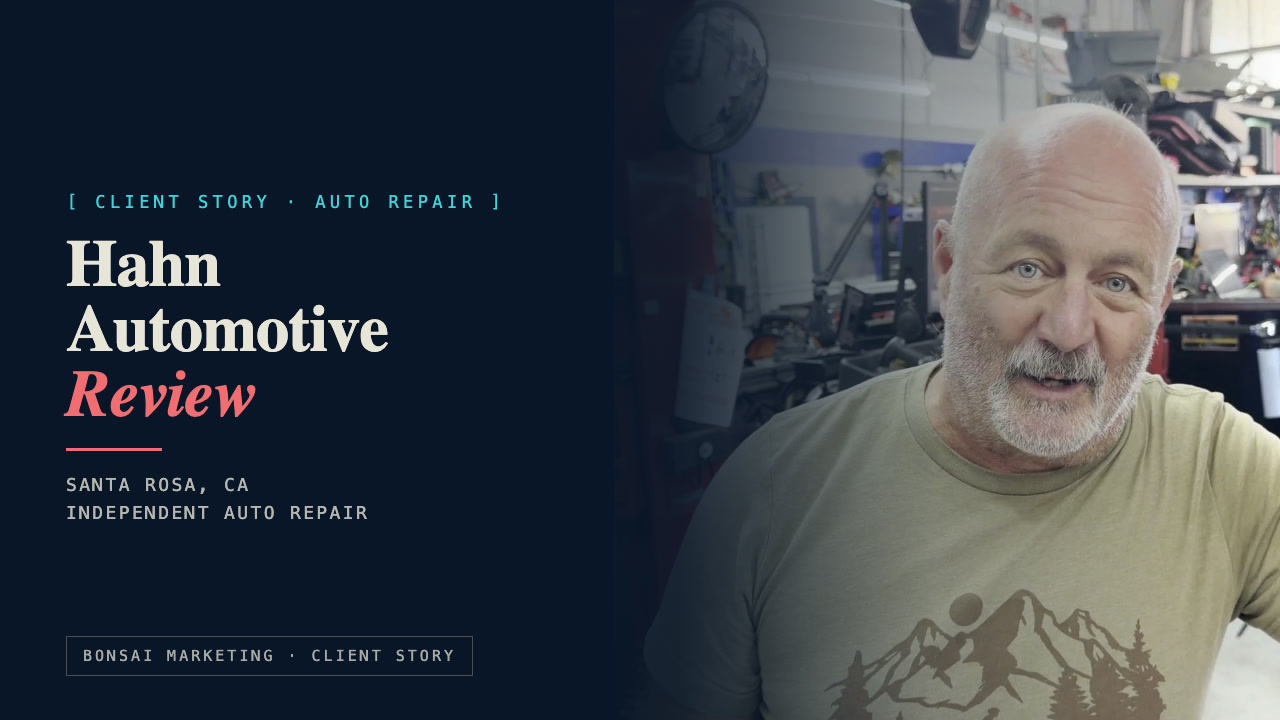
Hahn Automotive Review — Santa Rosa Auto Repair
A Santa Rosa auto repair shop owner doesn't track marketing by invoice — he tracks it as 3% of gross revenue. One metric. Fourteen seconds. Total clarity.
A Santa Rosa auto repair shop owner doesn't track marketing by invoice — he tracks it as 3% of gross revenue. One metric. Fourteen seconds. Total clarity.
Measuring marketing spend as a percentage of gross revenue is a discipline most small business owners skip entirely.
At 3% of gross, this shop owner has a built-in budget that scales with the business — it grows when revenue grows and tightens when it needs to.
The owner admits he doesn't fully understand what his marketing partner is doing — and it doesn't matter, because the results speak for themselves.
Trust in a marketing relationship is earned through outcomes, not explanations. This client stopped asking how and started measuring what.
Hahn Automotive's approach is a model for any independent auto repair shop that wants to stop guessing at marketing ROI.
A Santa Rosa auto repair shop owner just delivered one of the most honest and useful marketing statements you’ll hear from any small business owner: he doesn’t know exactly what his marketing team is doing, and he doesn’t need to. He knows he’s spending 3% of gross revenue, and he knows it’s working.
That combination — measured spend, trusted execution, verified results — is rarer than it should be.
The Metric That Changes Everything
Most independent shop owners think about marketing in terms of individual expenses. A mailer cost $400. A directory listing runs $150 a month. A website redesign hit $3,000 last year. Those numbers feel real because they show up on invoices.
But invoices don’t tell you whether you’re over-investing or under-investing. Gross revenue does.
When you set marketing spend as a percentage of gross, the budget becomes self-regulating. A strong revenue month means more fuel for visibility. A slower period means natural restraint. The business and the marketing breathe together.
Hahn Automotive landed on 3%. That’s the number their owner watches — not line items, not click reports, not monthly invoice totals. One number, tied directly to the health of the business.
Why Most Shop Owners Never Get Here
Getting to a clean percentage-of-gross framework requires two things most small business owners don’t have at the same time: a clear view of their revenue and enough trust in their marketing partner to stop micromanaging the tactics.
The Hahn Automotive owner says outright that he doesn’t fully understand what his marketing partner is doing. That’s not ignorance — that’s confidence. He’s evaluated the relationship on the only basis that matters: are excellent results showing up?
They are. So he stays focused on running a great shop.
What This Looks Like in Practice
For an independent auto repair business generating solid annual gross revenue, 3% is a meaningful but disciplined investment. It’s enough to maintain strong local search visibility — in Google Maps, Google AI Overviews, and increasingly in AI answer engines like ChatGPT, Perplexity, and Gemini, where people ask things like “best auto repair shop in Santa Rosa” and expect a confident, sourced answer.
It’s not enough to waste. Every dollar has to pull weight.
That constraint is a feature, not a bug. It forces the marketing to be focused, local, and results-oriented — which is exactly what hyper-local strategy demands.
The Trust Variable
There’s something else worth naming directly. The owner’s comfort with not understanding every tactic is a signal that the relationship is working the way a good client-agency relationship should.
When a business owner feels compelled to audit every deliverable and interrogate every decision, it usually means one of two things: the results aren’t there, or the agency hasn’t done the work of earning trust. Hahn Automotive has neither problem.
That’s the standard worth holding any marketing partner to — not perfect transparency into every tactic, but consistent, measurable performance that makes the question of “how” feel less important than “what’s next.”
A Model Worth Studying
Independent auto repair shops across the country run on thin margins, high competition, and word-of-mouth that doesn’t scale on its own anymore. The shops that grow market share in the next five years will be the ones that treat marketing as a business function with a real budget — not a discretionary expense that gets cut when cash gets tight.
Hahn Automotive isn’t waiting to figure that out. They already did.
The shops that adopt this mindset now will be the ones that own their local search landscape before their competitors realize what changed.
Answered.
What percentage of gross revenue should an auto repair shop spend on marketing? +
Hahn Automotive in Santa Rosa budgets approximately 3% of gross revenue for marketing. That figure keeps spend proportional to the business and eliminates the guesswork of per-campaign budgeting.
How does Hahn Automotive measure marketing success? +
The owner measures marketing as a percentage of gross revenue rather than evaluating individual invoices or campaigns. He reports excellent results at that spend level.
Does a business owner need to understand exactly how their marketing works to get results? +
Not according to this shop owner. He openly says he doesn't fully understand the mechanics behind his marketing — but he does understand his results, and that's what drives his confidence.
What is the Bonsai Marketing Digital Dojo? +
The Digital Dojo is Bonsai Marketing's video library featuring real client stories, strategy breakdowns, and local search insights for business owners who want to grow market authority.
Why do independent auto repair shops struggle with marketing budgets? +
Most shop owners price marketing reactively — spending when it feels necessary and cutting when money gets tight. Tying spend to a fixed percentage of gross revenue solves that problem by making the budget self-regulating.